
To do this, Earth Sciences New Zealand and the University of Wisconsin Space Science and Engineering Center (USA) are looking at far infrared radiation.
Principal Climate Scientist Dr Sam Dean says far infrared radiation makes up about half of the heat emitted by the Earth’s surface
“Far infrared radiation contributes to global warming via the greenhouse effect, particularly through water vapour, which is increasing in the atmosphere as a response to global warming. The more greenhouse gases and water vapour there are, the more far-infrared radiation is trapped in the atmosphere, and the more the planet warms,” said Dr Dean.
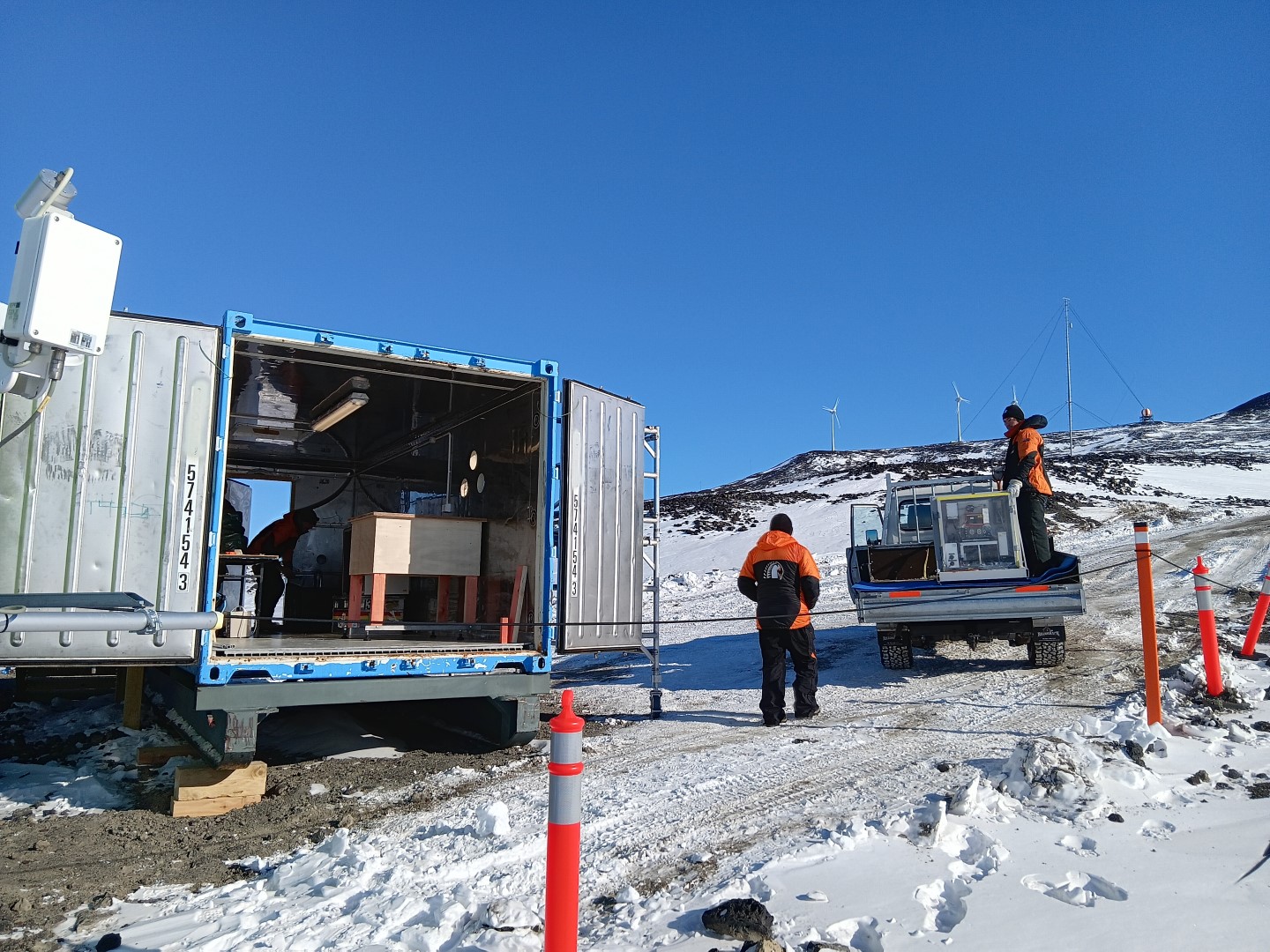
Earth Sciences NZ has just deployed an instrument called an Atmospheric Emitted Radiance Interferometer (AERI) to Antarctica, on loan from the U.S. Department of Energy. It will take novel observations of atmospheric infrared radiation, as well as constituents like greenhouse gases, over the next 12 months.

AntarcticaNZ science technician, Harry Offer, following the installation of the back-end of the AERI spectrometer.
These ground-based AERI measurements are being made in conjunction with NASA's PREFIRE mission – twin, shoebox-sized satellites that are orbiting the Earth and taking the same measurements of the poles from above. The satellites were launched from Māhia Peninsula by Rocket Lab in May and June 2024.
“AERI will look up as the PREFIRE satellites look down – something that’s never been done in Antarctica before. Warming over Antarctica is a great concern as it may combine with warming oceans to accelerate ice melt, something already being seen in Greenland,” said Dr Dean.
Morgan Connaughton, VP – Communications at Rocket Lab, said it’s exciting to see New Zealand scientists contributing to a globally important study leveraging spacecraft launched from right here in Aotearoa.
“Rocket Lab has launched many climate-focused missions, but being part of a mission that sees Kiwi scientists use data from satellites launched from home soil is particularly special. Space has an enormous role to play in how we better understand our planet and our impact on it. With the ability to build and launch spacecraft, and talented scientists and engineers to undertake groundbreaking studies, New Zealand is ideally positioned to be a leader in space science,” said Ms Connaughton.
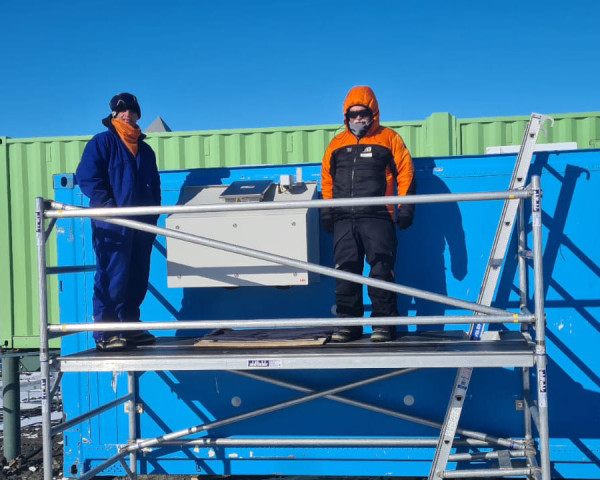
Gordon Brailsford and Dan Smale (ESNZ) beside the installed AERI instrument.
Earth’s poles are pivotal for helping maintain the planet’s temperature. Heating from the Sun mostly occurs in the tropics, where weather systems and oceans act to transport that heat polewards. Over Antarctica, heat is then strongly radiated to space.
“It’s vital we understand more about the greenhouse effect in the atmosphere above Antarctica and whether there are changes in the radiation to space. Our observations will allow for testing of scientific models of the greenhouse effect above Antarctica to make sure they’re correct, helping us to better predict how climate change will affect our polar regions, and vice versa,” he said.
Professor Tristan L'Ecuyer of the University of Wisconsin said the lack of far-infrared measurements has limited our knowledge of the Antarctic greenhouse effect that influences ice sheet temperature, melting and refreezing, and, ultimately, global sea level.
“This collaboration between NASA, the US Department of Energy and Earth Sciences New Zealand fills an important need for measurements from the ground to compliment the PREFIRE measurements and support polar climate studies,” he said.
This work is part of a larger international collaboration known as SHIRE: The Southern Hemisphere polar Infrared Radiation Experiment. The AERI instrument has been provided by the U.S. Department of Energy’s Atmospheric Radiation Measurement (ARM) User Facility, with Earth Sciences NZ and the University of Canterbury deploying several additional instruments to Antarctica in the coming weeks in support of SHIRE.
With support from Antarctica New Zealand, AERI will be deployed at Scott Base until at least October 2026.